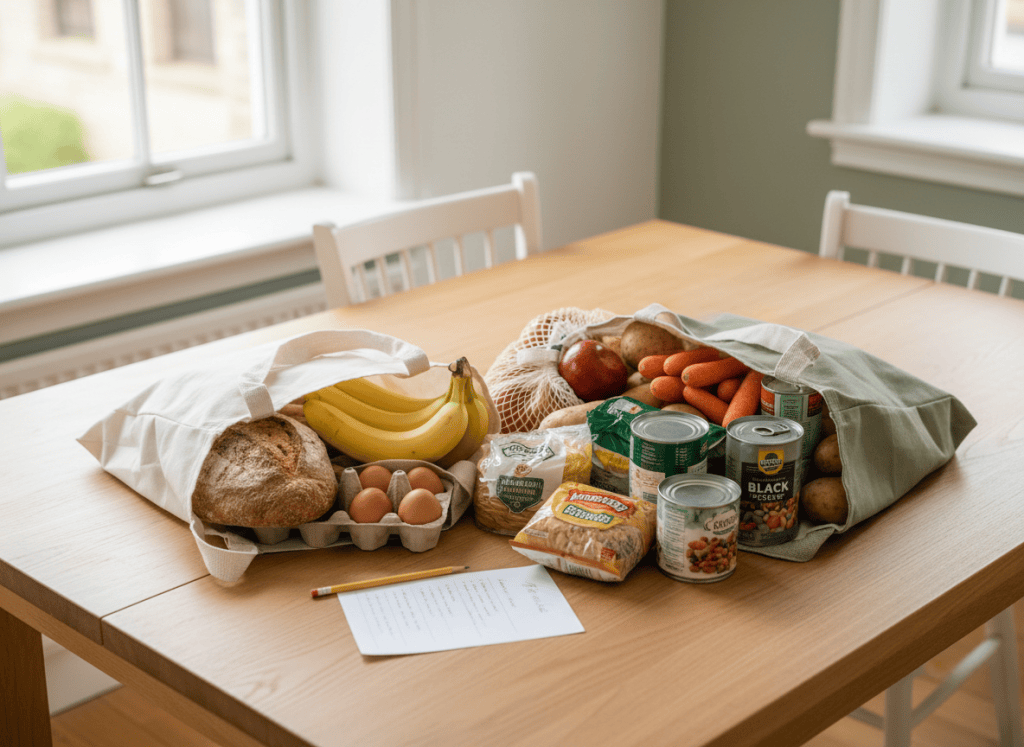
Walking into the grocery store with $150 to feed a family of four can feel a little overwhelming these days.
Groceries are expensive.
And when you’re trying to stay on a budget, it’s easy to look at a full shopping cart and wonder:
How did I spend that much money and still not have anything for dinner?
I think the answer is to shop with a plan.
If I had $150 to spend on groceries for a family of four for one week, my goal wouldn’t be to buy the cheapest food I could find.
My goal would be to buy food that works together.
I want breakfast, lunch and dinner options. I want some snacks. And I want ingredients I can use more than once.
Here’s how I would do it.
First, Plan the Meals
Before I ever walk into the grocery store, I want to know what we’re eating.
Not every single bite for the next seven days—but at least the main meals.
For this example, I’d plan dinners like these:
- Spaghetti with meat sauce, salad and garlic bread
- Chicken, rice and vegetables
- Tacos with beans and rice
- Baked potatoes topped with leftover chicken and cheese
- Breakfast for dinner with eggs, pancakes and fruit
- Homemade chicken and vegetable soup with grilled cheese
- Leftover night
Nothing fancy.
Just meals most families will recognize, with ingredients that can be used in several different ways.
Here’s How I’d Spend the $150
Prices vary depending on where you live and where you shop, so think of these amounts as targets rather than exact prices.
Meat and Protein — About $40
I’d look for:
- Chicken thighs or breasts — $12
- Ground beef or turkey — $10
- Eggs — $5
- Peanut butter — $3
- Canned beans — $4
- Shredded cheese — $6
Total: about $40
Notice that meat isn’t the biggest part of the grocery budget.
You don’t necessarily need a large piece of meat for every dinner.
Beans, eggs and peanut butter are inexpensive ways to add protein and help stretch the more expensive items.
Fruits and Vegetables — About $30
I’d choose produce that’s versatile and reasonably priced.
- Bananas — $3
- Apples — $5
- Potatoes — $5
- Carrots — $3
- Onions — $3
- Lettuce or salad mix — $4
- Frozen vegetables — $4
- Another seasonal fruit or vegetable — $3
Total: about $30
Don’t overlook frozen vegetables.
They’re convenient, they last longer and you don’t have to worry about throwing them away because you didn’t use them quickly enough.
Bread, Rice, Pasta and Other Basics — About $30
This is where I can really make the budget stretch.
- Bread — $4
- Tortillas — $3
- Rice — $4
- Pasta — $3
- Pasta sauce — $4
- Oatmeal — $4
- Pancake mix — $3
- Cereal — $5
Total: about $30
These are foods that can become the foundation of several meals instead of being used once and forgotten.
Dairy — About $15
- Milk — $4
- Yogurt — $5
- Butter or margarine — $4
- Extra cheese or another dairy item — $2
Total: about $15
If milk is $5 where you shop, something else on the list may need to come down by a dollar. That’s budgeting in real life.
Lunches and Snacks — About $20
I’d use some of the food I’ve already purchased for lunches. Leftovers can become lunch the next day. Peanut butter sandwiches, grilled cheese, soup and eggs can also fill in the gaps.
- Crackers — $3
- Popcorn — $3
- Extra fruit — $5
- Lunch meat or another sandwich option — $6
- A small treat — $3
Total: about $20
And yes, I included a treat. A grocery budget doesn’t have to mean nobody gets anything fun.
Leave $15 for the Things You Forgot
So far we’ve spent about $135.
I’d try very hard not to spend that last $15 before I get to the store.
Because there’s almost always something you forgot—coffee, ketchup, school lunch supplies, or an item that costs more than expected.
That last $15 gives your grocery budget some breathing room.
The $150 Breakdown
- Meat and protein: $40
- Fruits and vegetables: $30
- Bread, rice, pasta and basics: $30
- Dairy: $15
- Lunches and snacks: $20
- Extra cushion: $15
Total: $150
You don’t have to divide your money exactly this way. The important part is giving your money a job before you start putting things in your cart.
Shop Your Kitchen First
Before you go shopping, take five minutes and look through your refrigerator, freezer and pantry.
You may already have rice, ground beef, pasta sauce, canned vegetables or oatmeal.
Use what you already have.
If you already have $15 worth of ingredients for this week’s meals, that gives you $15 to buy something else—or $15 you don’t have to spend at all.
Don’t Let a Sale Decide What’s for Dinner
A sale is only a bargain if you can actually use the food.
I like to ask myself: What meal am I going to make with this?
If I don’t have an answer, I probably don’t need it.
Store Brands Can Make a Big Difference
There are certain things where I don’t mind buying the store brand at all: rice, pasta, canned vegetables, oatmeal, flour, sugar, frozen vegetables and basic pantry staples.
Saving 50 cents or a dollar may not sound impressive, but saving a little on 10 or 15 items can make a noticeable difference at the checkout.
Make Your Ingredients Work Twice
This may be my favorite grocery-budget rule.
Don’t buy an ingredient for only one meal if you can help it.
Cook extra chicken one night. Use some for dinner and save some for baked potatoes or sandwiches.
If you make taco meat, save a little for nachos or a taco salad. Cook a larger pot of rice and use it with two different meals.
One ingredient doesn’t have to mean one dinner. That’s how you make $150 stretch.
Give Yourself a Challenge
Before you head to the grocery store this week, decide how much you’re going to spend.
If your number is $150, make your list and try to come in under it.
If the total comes to $142 instead of $150, don’t find another $8 worth of things to buy.
Keep the $8. Put it in savings, add it to your emergency fund, or leave it in your grocery budget for next week.
Eight dollars may not seem like much. But remember: Small amounts count.
Feeding a family on a budget isn’t about creating perfect meals or never buying something you enjoy.
It’s about walking into the store with a plan instead of hoping everything works out when you reach the register.
Plan your meals. Shop your kitchen. Make a list. Use ingredients more than once. And give every grocery dollar a purpose.
That’s how I’d make $150 work for a family of four.

