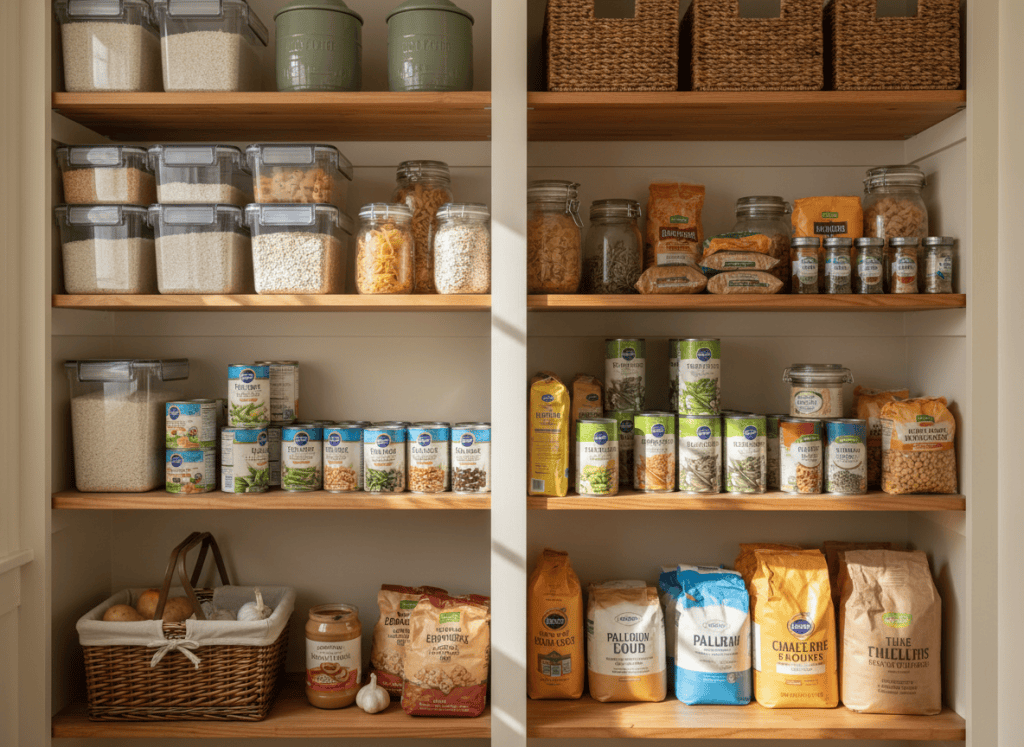
Have you ever looked at pictures of beautifully stocked pantries and thought:
That must have cost a fortune.
It probably did.
But here’s the good news: you don’t need to spend hundreds of dollars at one time to build a useful pantry.
You can start with $10 a week.
That’s it.
Ten dollars added to your regular grocery budget each week can slowly build a supply of food that gives you more options when money is tight, you don’t have time to grocery shop, or you simply need to pull together a quick meal.
So let’s try something.
The $10-a-Week Pantry Challenge
For the next 10 weeks, set aside $10 from your grocery budget specifically for your pantry.
After 10 weeks, you’ll have invested about $100.
The goal isn’t to have shelves overflowing with food.
The goal is to build a pantry filled with things your family will actually eat and use.
And remember, prices vary from store to store. You don’t have to buy these exact items or spend exactly $10 every week.
Use store brands. Shop sales. Substitute when something is expensive.
The plan is more important than the exact list.
Before You Buy Anything
Start by looking through your pantry, cabinets, refrigerator and freezer.
You may already have more than you realize.
If you already have three boxes of pasta, don’t buy more pasta just because it’s on my list.
Use that week’s $10 for something you’re missing.
We’re building a useful pantry—not collecting food just for the sake of having full shelves.
Week 1: Rice and Pasta
Let’s start with inexpensive foods that can become the foundation of a meal.
- Rice
- Pasta
- Macaroni
- Egg noodles
Rice can go with chicken, beans, vegetables, casseroles and stir-fry. Pasta can become spaghetti, pasta salad, casseroles or a quick side dish.
Week 2: Canned Vegetables
This week, spend your $10 on canned vegetables your family actually likes.
- Green beans
- Corn
- Peas
- Carrots
- Mixed vegetables
- Tomatoes
Watch for sales and store brands. They last much longer than fresh vegetables and can help round out a meal.
Week 3: Beans and Other Inexpensive Protein
- Black beans
- Pinto beans
- Kidney beans
- Chickpeas
- Dried beans
- Canned tuna, if the price fits your budget
Beans are one of my favorite budget foods because they can stretch other ingredients.
You don’t always need more meat. Sometimes you just need to make the meat you bought go further.
Week 4: Tomato Products and Sauces
- Pasta sauce
- Canned tomatoes
- Tomato sauce
- Tomato paste
- Pizza sauce
Think about what your family eats. Pasta plus sauce can become dinner. Rice, beans and tomatoes can become another meal. Tomatoes can go into soup, chili or casseroles.
Week 5: Breakfast Staples
- Oatmeal
- Pancake mix
- Syrup
- Cereal
- Peanut butter
- Grits
Oatmeal is especially useful because it can be inexpensive and filling. And don’t forget one of my favorite inexpensive dinners: breakfast for dinner.
Week 6: Soup and Quick Meals
- Canned soup
- Broth
- Ramen
- Boxed macaroni and cheese
- Boxed rice or pasta mixes
Having a few quick options can keep you from spending $40 or $50 on takeout because everyone is hungry and there’s “nothing to eat.”
Week 7: Baking Basics
- Flour
- Sugar
- Cornmeal
- Baking mix
- Baking soda
- Baking powder
You don’t need to buy all of these at once. Choose the things you’re most likely to use.
Week 8: Flavor Builders
- Taco seasoning
- Garlic powder
- Onion powder
- Italian seasoning
- Chili powder
- Bouillon
- Gravy mix
- Soy sauce
- Your family’s favorite seasoning
You don’t need 30 different spices. Start with the seasonings you use most often.
Week 9: Snacks and Extras
- Popcorn
- Crackers
- Pretzels
- Applesauce
- Granola bars
- Peanut butter
- Raisins
Again, buy what your family will actually eat. Having an inexpensive snack at home can reduce little convenience-store and drive-thru purchases that add up quickly.
Week 10: Fill the Gaps
This may be the most important week.
Don’t follow a list. Look at what you’ve built. What are you missing?
Your pantry should fit your family—not mine.
What Could You Have After 10 Weeks?
- Rice
- Several kinds of pasta
- Canned vegetables
- Beans
- Tuna
- Pasta sauce
- Canned tomatoes
- Oatmeal
- Pancake mix
- Peanut butter
- Soup
- Broth
- Quick meal options
- Flour and sugar
- Seasonings
- Snacks
You didn’t buy it all at once. You built it $10 at a time.
Now Comes the Important Part: Use It
A pantry isn’t a museum.
Eat the food.
If you use two cans of green beans this week, put green beans back on your list when there’s room in the budget. Use older items first and put newer items behind them. Occasionally check expiration or best-by dates so food doesn’t get forgotten.
Your Pantry Can Help on a Hard Week
Imagine you normally spend $150 at the grocery store, but one week the car needs a repair.
Money is tight.
You look in your pantry and already have pasta, rice, beans, canned vegetables, soup, oatmeal and several other basics.
Instead of buying everything for every meal, you’re filling in around what you already have.
That’s when those $10 purchases from previous weeks start paying you back.
Don’t Go Into Debt to Stock a Pantry
Please don’t put $300 worth of pantry food on a credit card because someone on social media has beautiful shelves filled with matching containers.
That’s not the goal.
A useful pantry doesn’t have to be beautiful. It doesn’t need matching baskets. And it definitely doesn’t need to put you in debt.
Food on the shelf that you can afford is much more valuable than a picture-perfect pantry you charged to a credit card.
Keep the Challenge Going
Once the first 10 weeks are over, you don’t have to stop.
Keep your $10 pantry budget, but now you can be more strategic.
If pasta sauce is normally $3 and goes on sale for $1.50, maybe you buy a few. If canned vegetables are on sale, restock them.
Over time, that little $10 habit can create something valuable: options.
You don’t need to build your pantry in one giant shopping trip. You don’t need hundreds of dollars. You don’t need perfect shelves.
Start with $10.
Next week, add another $10.
Ten weeks from now, you may be surprised by how much you’ve built.
Just like saving money, building a pantry doesn’t have to start big.
It just has to start.

